
Phone

+603-5621 5786

Business Hour

08:30 - 17:30

Mahr Metrology MarSurf LD  260 Aspheric 2D and 3D

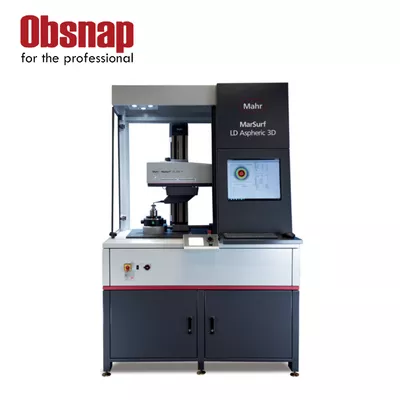
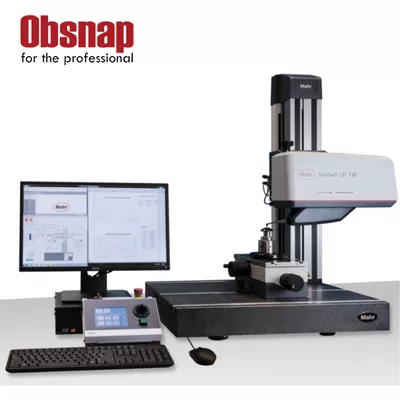
The MarSurf LD 130 / LD 260 is a high-precision 2D/3D surface measuring station for contour and roughness analysis of optical components. It enables real 3D measurements with sub-nanometer resolution and flexible probe positioning.

  • Measuring range X-axis: 0.1 mm up to 130 mm (LD 130) / 260 mm (LD 260)
  • Positioning speed: 0.02–200 mm/s
  • Measuring speed: 0.02–10 mm/s (recommended 0.1–0.5 mm/s for roughness)
  • Measuring point spacing: 0.05 µm – 30 µm (adjustable)

Description

The MarSurf LD 130 / LD 260 provides a highly precise 2D and 3D solution for characterizing optical surfaces, including aspheres, lenses, and rotationally symmetrical components. It ensures early detection of surface deviations, enabling operators to eliminate time-consuming post-processing and improve production quality. With real 3D measurements in just 5–10 minutes, the system delivers accurate linear and polar point density data, making it ideal for machine-controlled feedback loops.

The system combines flexible probe positioning with automatic y-axis centering, allowing for free movement of the probe tip and measurement of steep flanks or large lenses without recalibration. Thanks to vertical resolution of 0.8 nm, form deviations <100 nm, and extremely low system noise, users can achieve unmatched measurement accuracy and repeatability. The active antivibration system and stable temperature management ensure reliable measurements in production environments, while a wide measuring range up to 260 mm allows for versatile application across optical and precision components.

With its high-speed dynamics, the MarSurf LD series can adapt to both micro-lenses requiring ultra-slow scans and large lenses needing rapid measurement, providing maximum flexibility for modern optical manufacturing.
Features

  • Real 3D surface measurement with 0.8 nm vertical resolution

  • Adjustable X-axis measuring range: 130 mm (LD 130) / 260 mm (LD 260)

  • High-speed measuring dynamics: 0.02–10 mm/s

  • Probe measuring range: 13–26 mm, electronically adjustable measuring force (0.5–30 mN)

  • Max points per scan: 2.6M (LD 130) / 5.2M (LD 260)

  • Form error: ≤ 100 nm (2D), ≤ 200 nm (3D)

  • Slope measurement capability: < ±45°

  • High-precision spindle with radial/axial error limits ±0.01–0.02 µm

  • Automatic y-axis centering and active antivibration system

  • Temperature-controlled operation: 15–35 °C, recommended 20 °C ±2 K

  • Applications: Optical lens topography, roughness, contour, asphere measurements

  • Machine-readable output for controlling processing machines

Specifications

Properties of the horizontal axis X
Traversing length 0.1 mm up to 130 mm / 260 mm
Positioning speed 0.02 mm/s up to 200 mm/s
Measuring speed 0.02 mm/s to 10 mm/s

for roughness measurement recommended: 0.1 mm/s to 0.5 mm/s

Measuring point spacing 0.05 μm up to 30 μm, adjustable
Max number of points in one scan 2.6 million points (MarSurf LD 130) / 5.2 million points (MarSurf LD 260)
Resolution 0.8 nm (0.03 μin)
Uncertainty X-axis display ± (0.2+l/1000) μm; l in mm
System noise < 5 nm RMS
Surface roughness < 5 nm
Technical data probe system (Measuring direction Z+ / Z-)
Probe measuring range 13 mm

(100 mm probe arm) 26 mm

(200 mm probe arm)

Resolution 0.8 nm
Measuring force 0.5 mN up to 30 mN (electronically adjustable)
High precision spindle (3D version)
Radial error limit ± (0.01 + 0.00025H) μm;

H = height above table

Axial error limit ± (0.02 + 0.0001R) μm;

R = radius form center

Resolution 0.00025°
Positioning control < ± 0.02°
Accuracy precision centering < 0.8 μm
Accuracy precision levelling < 0.006°
Contour – display deviation
Distance measurement EA MPEEA = ± (1.0+l/150)μm,

l in mm

Radius measurement RK

R < 10 mm

10 mm < R < 300 mm

R > 300 mm


MPER = ± 1.0 μm

MPER = ± (0.17+R/12) μm MPER = ± (-18+R/7) μm

Form error ≤ 100 nm (2D)*

≤ 200 nm (3D)*

Slope < ± 45°
Real 3D Measurement
Measuring time typically 5 to10 min
Point density typically: 1 μm linear, 0.1° polar 3D: Number of polar traces + inter- polation
Drive unit with automatic y-axis for centering
General Data
Operating temperature + 15°C to + 35°C
Suggested working temperature 20°C ± 2K
Temperature change < 0.5 K/h
Active antivibration system

Ready to Transform Your Business? Contact Us Today

Categories

Request a Quote or Further Information

Please fill in the request form below and one of our engineers will contact you to discuss your system requirements and if we can help, our typical response time is within 1 – 3 working day.