Phone

+603-5621 5786

Business Hour

08:30 - 17:30

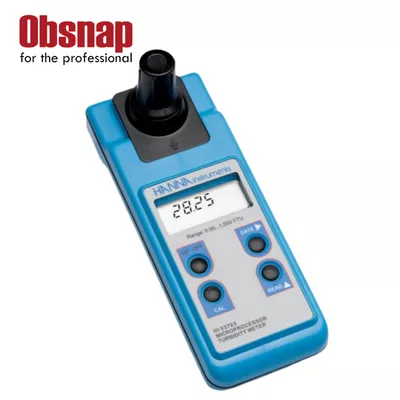
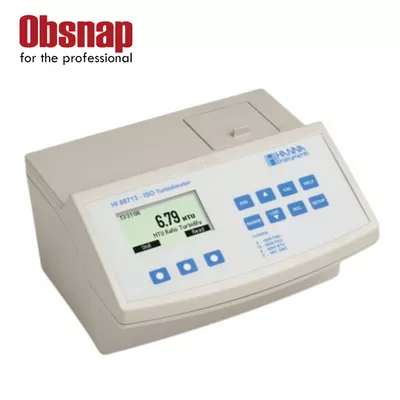
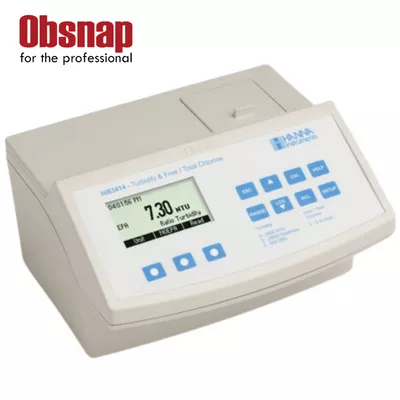
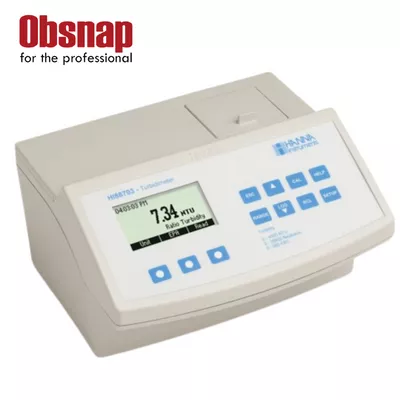
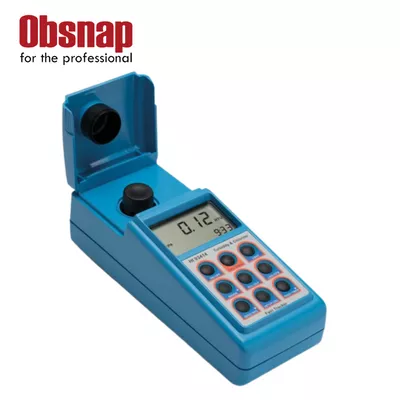
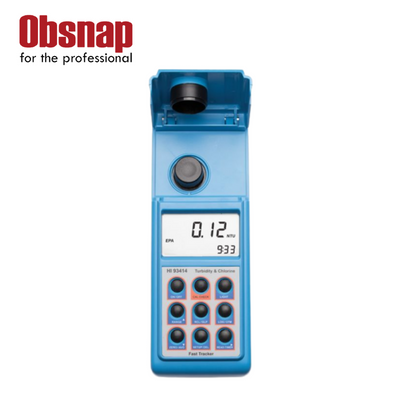
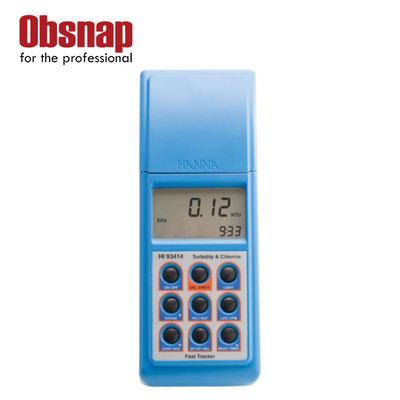
Hanna Instruments HI93414-02 Turbidity (EPA) and Chlorine Portable Meter

The HI93414 is a portable turbidity and chlorine meter with good accuracy. The most crucial elements in drinking water quality—turbidity and chlorine—are measured by this meter, which combines a nephelometer and a photometer.

The meter is delivered fully equipped with main turbidity standards AMCO-AEPA-1 and secondary chlorine standards NIST traceable, which are utilized for calibration and performance verification.

For turbidity measurements, the HI93414 satisfies and goes above the standards of EPA Method 180.1 and Standard Methods for the Examination of Water and Wastewater 2130 B. The chlorine measurements are made using the Standard Method 4500-Cl G and EPA Method 330.5, respectively.

  • Fast Tracker – Tag Identification System (T.I.S)
  • USB for data transfer
  • Operates on batteries or line voltage

Description

Turbidity and chlorine, which are two of the most crucial elements in drinking water, are measured by the multiparameter device known as the HI93414. The gadget uses a cutting-edge optical technology to minimize stray light and color interferences and deliver accurate readings. Any changes in the tungsten lamp’s intensity are offset by routine calibration using the provided standards.

In order to preserve the correct wavelength for the measurement of free and total chlorine, the colorimeter part of the meter uses a 525 nm narrow band interference filter. To achieve the highest level of repeatability for turbidity and chlorine measurements, all measurements are carried out using 25 mm round cuvettes made of specialized optical glass.

Features at-a-glance:

Three Measurement Modes – The HI93414 features three options for measurement including ratio mode for turbidity, free chlorine, and total chlorine. Turbidity measurements can be made in the 0.00 to 1000 NTU (Nephelometric Turbidity Units) range, while free or total chlorine measurements can be made in the 0.00 to 5.00 mg/L (ppm) range.

Multiple reading modes – Normal measurement, continuous measurement, or signal averaging measurement are reading modes available

EPA Compliant –  The HI93414 meets and exceeds the requirements of EPA and Standard Methods both for turbidity and colorimetric chlorine measurements. When the meter is in EPA mode all turbidity readings are rounded accordingly to meet reporting requirements.

Calibration – A two, three, or four-point turbidity calibration can be performed by using the supplied (<0.10, 15.0, 100, and 750 NTU) standards. Calibration points can be modified if user-prepared standards are used. For free and total chlorine, the 1.00 mg/L (ppm) CAL Check standard can be used for calibration and performance verification.

AMCO AEPA-1 Primary Turbidity Standard – The AMCO AEPA-1 supplied standards are recognized as a primary standard by the USEPA. These non-toxic standards are made of styrene divinylbenzene polymer spheres that are uniform in size and density. The standards are reusable and stable with a long shelf life.

CAL Check  – With the powerful CAL Check function, reliable performance of the chlorine colorimeter can be validated at any moment by using the exclusive HANNA ready-made, NIST traceable standards.  All standards are supplied with a Certificate of Analysis (COA) for traceability.

Fast Tracker  – For advanced ˜field applications, the HI93414 is equipped with Fast Tracker – Tag Identi˜fication System (T.I.S.) that makes data collecting and management simpler than ever. Fast Tracker allows users to record the time and location of a speci˜fic measurement or series of measurements using iButton® tags near sampling points for quick and easy readings. Each iButton® tag contains a computer chip with a unique identi˜cation code encased in stainless steel.

GLP Data – The HI93414 features complete GLP (Good Laboratory Practice) functions that allow traceability of the calibration conditions. Data includes calibration points, date, and time.

Data Logging – Up to 200 measurements can be stored in the internal memory and recalled at any time.

Data Transfer – For further storage or analysis options, logged data can be downloaded to a Windows compatible PC using the RS232 or USB ports and the HI92000 software.

Backlit Display – A backlit LCD display provides an easy to understand, user-friendly interface. Displayed codes guide the user step-by-step through routine operation and calibration.

One of the most crucial factors used to assess the quality of drinking water is turbidity. There is significant evidence that reducing turbidity is an effective defense against infections, despite it once being thought of as a mostly aesthetic property of drinking water. Turbidity measurements are made in natural water to assess the water’s general quality and suitability for uses involving aquatic creatures. Turbidity management used to be the only factor considered in the monitoring and treatment of wastewater. To confirm that the values meet legal standards, turbidity monitoring is currently required at the end of the wastewater treatment process.
Water turbidity is an optical characteristic that prevents light from being transferred and instead scatters and absorbs it. The suspended solids in a liquid play a major role in scattering light as it moves through it. The amount of light scattered increases with turbidity. Since there will always be some turbidity in a solution, even a perfectly pure liquid will occasionally scatter light.
The EPA mandates the monitoring and reporting of turbidity at drinking water treatment facilities that use surface water as a source of water. Lakes and rivers are sources of surface water. Nephelometer requirements for reporting measurements in accordance with EPA Method 180.1 are as follows:
  • The applicable range is 0-40 nephelometric turbidity units (NTU)
  • Light source:  Tungsten lamp operated at a color temperature between 2200-3000°K.
  • Distance traversed by incident light and scattered light within the sample tube: Total not to exceed 10 cm.
  • Detector: Centered at 90° to the incident light path and not to exceed ±30° from 90°. The detector, and filter system if used, shall have a spectral peak response between 400 nm and 600 nm
  • The sensitivity of the instrument should permit detection of a turbidity difference of 0.02 NTU or less in waters having turbidities less than 1 unit.
  • Report results as follows:
NTU reading Rounded to nearest
0.0 – 1.0 0.05
1 – 10 0.1
10 – 40 1
40 – 100 5
100 – 400 10
400 – 1000 50
>1000 100

The HI93414 meets and exceeds the meter criteria speci˜ed by the EPA Method 180.1 and Standard Methods for the Examination of Water and Wastewater 2130 B.

Principle of Operation

The sample scatters the light beam that passes through it in all directions. Numerous factors, including the wavelength of the incident light, the size and shape of the particles, the refractive index, and the color, influence the intensity and pattern of the scattered light. A tungsten filament lamp, a scattered light detector (90 degrees), and a transmitted light detector (180 degrees) are all parts of the HI93414’s optical system.
Using an efficient algorithm that corrects and accounts for color interferences, the instrument’s microprocessor determines the NTU value from the signals that reach the two detectors in the ratio turbidimeter range. The optical system and measuring method also account for variations in lamp intensity, reducing the frequency of calibration requirements.
The signal on the scattered light detector (90°) is used to determine the NTU value in the non-ratio turbidimeter range. This approach has a good linearity in the low range but is more susceptible to variations in light intensity. The stray light that is detected by the sensors but is not brought on by light scattering from suspended particles determines the lower detection limit of a turbidimeter. For low turbidity samples, the HI93414’s optical system is made to have very little stray light, producing extremely accurate readings.
Measurements must be traceable to primary reference materials, which is ensured by the HI98703-11 AMCO AEPA-1 standards. The HI93414 turbidity meter’s calibration and performance are verified using these standards.

Supplied with Certificate of Analysis

  • Lot number
  • Expiration date
  • Standard value @ 25 °C
  • Reference meter NIST traceable

Provided storage containers

  • Light tight
  • Protects from accidental breakage


CAL Check™ standards with certificate

The HI93414-11 free and total chlorine CAL Checkstandards are used for calibration and performance verification of the HI93414.

Supplied with Certificate of Analysis

  • Lot number
  • Expiration date
  • Standard value @ 25 °C
  • Reference meter NIST traceable

Provided storage containers

  • Light tight
  • Protects from accidental breakage
More Information
SKU HI93414-02
Product Name Turbidity (EPA) and Chlorine Portable Meter – HI93414
Quote Required Yes
Turbidity Range 0.00 to 9.99; 10.0 to 99.9; 100 to 1000 NTU
Turbidity Resolution 0.01; 0.1; 1 NTU
Turbidity Accuracy ±2% of reading plus 0.02 NTU
Turbidity Repeatability ±1% of reading or 0.02 NTU, whichever is greater
Turbidity Stray Light < 0.02 NTU
Turbidity Calibration two, three, or four-point calibration
Turbidity Measuring Method ratio nephelometric method (90° & 180°)
Turbidity Measuring Modes normal, average, continuous
Turbidity Light Source tungsten filament lamp
Turbidity Light Detector silicon photocell
Logging Memory 200 records
Connectivity USB or RS232
Automatic Shut-Off auto-off after 15 minutes of non-use
Display 40 x 70 mm graphic LCD (64 x 128 pixels) with backlight
Battery Type/Life 4 (1.5V) AA alkaline batteries
Power Supply 4 (1.5V) AA alkaline batteries or AC adapter
Environment 0 to 50°C (32 to 122°F), RH max 95% non-condensing
Dimensions 224 x 87 x 77 mm (8.8 x 3.4 x 3.0”)
Weight 512 g (18 oz.)
Photometer/Colorimeter Light Source Tungsten filament lamp
Photometer/Colorimeter Light Detector Silicon photocell with 525 nm narrow band interference filters
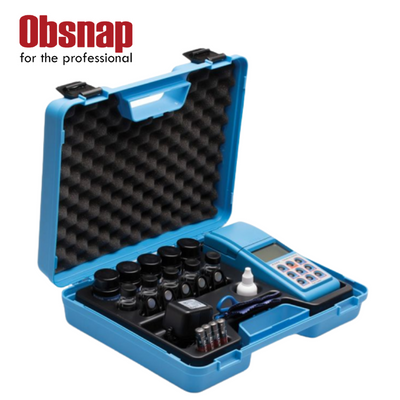
Ordering Information HI93414 is supplied with sample cuvettes and caps (5), calibration cuvettes for turbidity and chlorine, silicone oil, cuvette wiping cloth, scissors, batteries, AC adapter, instruction manual, and rugged carrying case.
Free Chlorine Range 0.00 to 5.00 mg/L
Free Chlorine Resolution 0.01 mg/L from 0.00 to 3.50 mg/L; 0.10 above 3.50 mg/L
Free Chlorine Accuracy ±0.02 mg/L @ 1.00 mg/L
Total Chlorine Range 0.00 to 5.00 mg/L
Total Chlorine Resolution 0.01 mg/L from 0.00 to 3.50 mg/L; 0.10 above 3.50 mg/L
Total Chlorine Accuracy ±0.02 mg/L @ 1.00 mg/L
Chlorine Method Adaptation of the USEPA Method 330.5 and Standard Method 4500-Cl G. The reaction between chlorine and DPD reagent causes a pink tint in the sample.

Ready to Transform Your Business? Contact Us Today

Categories

Request a Quote or Further Information

Please fill in the request form below and one of our engineers will contact you to discuss your system requirements and if we can help, our typical response time is within 1 – 3 working day.