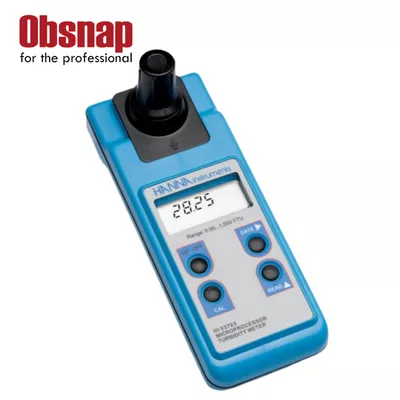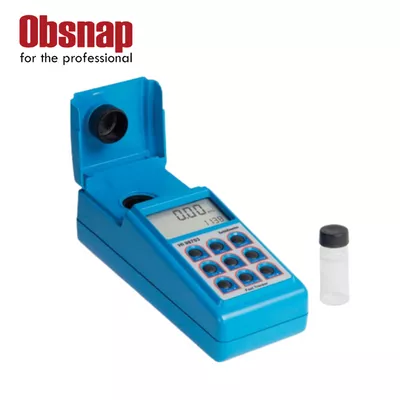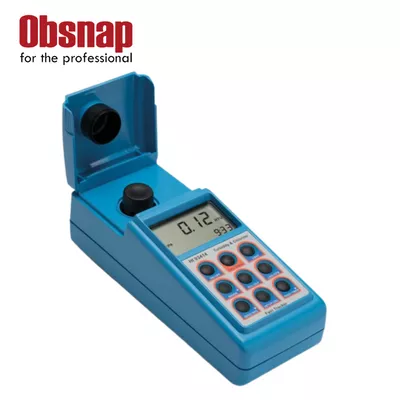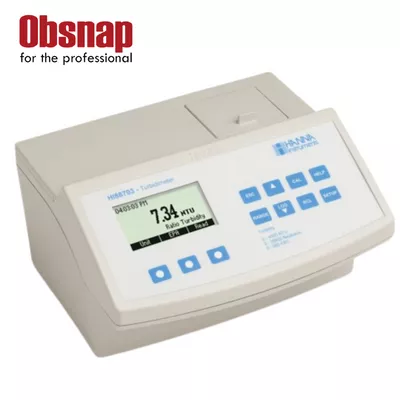
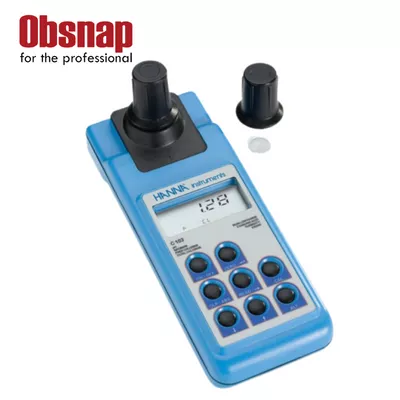
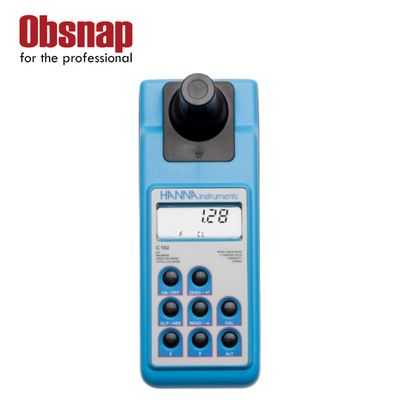
Description
Features at-a-glance
AMCO AEPA-1 Primary Turbidity Standard – The AMCO AEPA-1 standards for the turbidity range of the HI93102 are recognized as a primary standard by the USEPA. These non-toxic standards are made of styrene divinylbenzene polymer spheres that are uniform in size and density. The standards are reusable and stable with a long shelf life.
Logging – The HI93102 allows users to log up to 25 measurement readings. Measurement logs can easily be recalled with the press of a button and a reminder will appear if the memory becomes full. The logging mode can be enabled or disabled.
GLP – With a press of the “GLP” button on the face of the meter, users can view the date, time, and two calibration values of the current mode.
Auto-shut Off – Automatic shut off is selectable after 10, 20, 30, 40, 50, or 60 minutes of non-use when the meter is in measurement mode. This feature prevents wastage of batteries in the event the meter is accidentally left on.
Battery Status Indicator – The status of the battery is monitored during every measurement cycle. An indicator will warn the user when the amount of battery life left is not sufficient to take reliable measurements.
Error Codes – Helpful diagnostic codes appear on the display alerting to problems including low light, high light, or sample out of range.
Significance of Use
HOCl ↔ H+ + OCl–
hypochlorous acid ↔ hydrogen ion + hypochlorite ion
Principle of Operation
When measuring turbidity, the light beam that passes through the sample is scattered in all directions. The intensity and pattern of the scattered light is affected by many variables, such as wavelength of the incident light, particle size and shape, refractive index, and color. The optical system of the HI93102 includes an LED light source and a scattered light detector (90°).
Principle of Operation: Colorimetric Mode
A parameter-specific reagent is introduced to the sample for measuring certain ions in colorimetric mode, causing a color shift; the darker the color, the higher the concentration. The Beer-Lambert Law is then used to colorimetrically examine the resulting color change. According to this concept, light is absorbed by a complimentary hue, and the amount of radiation that is emitted depends on the concentration.
A narrow band interference filter at 525 nm (green) excludes all other visible light output from the light source, allowing only green light to be detected by the silicon photodetector for the purpose of determining free and total chlorine, cyanuric acid, pH, iodine, bromine, and low range iron. The absorbance of the particular wavelength of light increases together with the color change of the reacting sample, whereas transmittance decreases.
| SKU | HI93102 |
|---|---|
| Product Name | Portable Multiparameter Turbidity and Ion Specific Meter – HI93102 |
| Quote Required | Yes |
| pH Range | 5.9 to 8.5 pH |
| pH Resolution | 0.1 pH |
| pH Accuracy | ±0.1 pH |
| pH Method | Phenol red method. The reaction with reagents causes a red tint in the sample. |
| Turbidity Range | 0.00 to 50.0 NTU |
| Turbidity Resolution | 0.01 (0.00 to 9.99); 0.1 NTU (10.0 to 50.0) |
| Turbidity Accuracy | ±0.5 NTU or ±5% of reading (whichever is greater) |
| Turbidity Calibration | two-point; selectable between 0.00 – 50.0 FTU (0.00 and 20.0 FTU recommended) |
| Turbidity Light Source | pure green LED |
| Turbidity Light Detector | silicon photocell |
| Bromine Range | 0.00 to 8.00 mg/L |
| Bromine Resolution | 0.01 mg/L |
| Bromine Accuracy | ±0.08 mg/L (ppm); ±3% of reading |
| Bromine Method | Adaptation of the Standard Methods for the Examination of Water and Wastewater, 20th edition, DPD method. The reaction between bromine and the reagent causes a pink tint in the sample. |
| Free Chlorine Range | 0.00 to 2.50 mg/L |
| Free Chlorine Resolution | 0.01 mg/L |
| Free Chlorine Accuracy | ±0.03 mg/L (ppm); ±3% of reading |
| Total Chlorine Range | 0.00 to 3.50 mg/L |
| Total Chlorine Resolution | 0.01 mg/L |
| Total Chlorine Accuracy | ±0.03 mg/L (ppm); ±3% of reading |
| Chlorine Method | adaptation of the USEPA method 330.5 and Standard Method 4500-Cl G. The reaction between chlorine and the reagents causes a pink tint in the sample. |
| Cyanuric Acid Range | 0 to 80 mg/L |
| Cyanuric Acid Resolution | 1 mg/L |
| Cyanuric Acid Accuracy | ±1 mg/L (ppm); ±15% of reading |
| Cyanuric Acid Method | Adaptation of the turbidimetric method. The reaction between cyanuric acid and the reagent causes a white suspension in the sample. |
| Iodine Range | 0.0 to 12.5 mg/L |
| Iodine Resolution | 0.1 mg/L |
| Iodine Accuracy | ±0.1 mg/L (ppm); ±5% of reading |
| Iodine Method | Adaptation of the Standard Methods for the Examination of Water and Wastewater, 20th edition, DPD method. The reaction between iodine and the reagent causes a pink tint in the sample. |
| Iron Range | 0.00 to 1.00 mg/L |
| Iron Resolution | 0.01 mg/L |
| Iron Accuracy | ±0.02 mg/L (ppm); ±3% of reading |
| Iron Method | Adaptation of the TPTZ method. The reaction between iron and the reagent causes a violet tint in the sample. |
| Photometer/Colorimeter Light Source | pure green LED |
| Photometer/Colorimeter Light Detector | silicon photocell |
| Battery Type/Life | 4 (1.5V) AA / approximately 60 hours of continuous use or 1000 measurements |
| Automatic Shut-Off | automatic shut-off selectable after 10, 20, 30, 40, 50 or 60 minutes of non-use |
| Environment | 0 to 50°C (32 to 122°F); RH max 95% (non condensing) |
| Weight | 510 g (1.1 lb.) |
| Dimensions | 220 x 82 x 66 mm (8.7 x 3.2 x 2.6’’) |
| Ordering Information | HI93102 is supplied with measurement cuvette cap, batteries and instruction manual. |